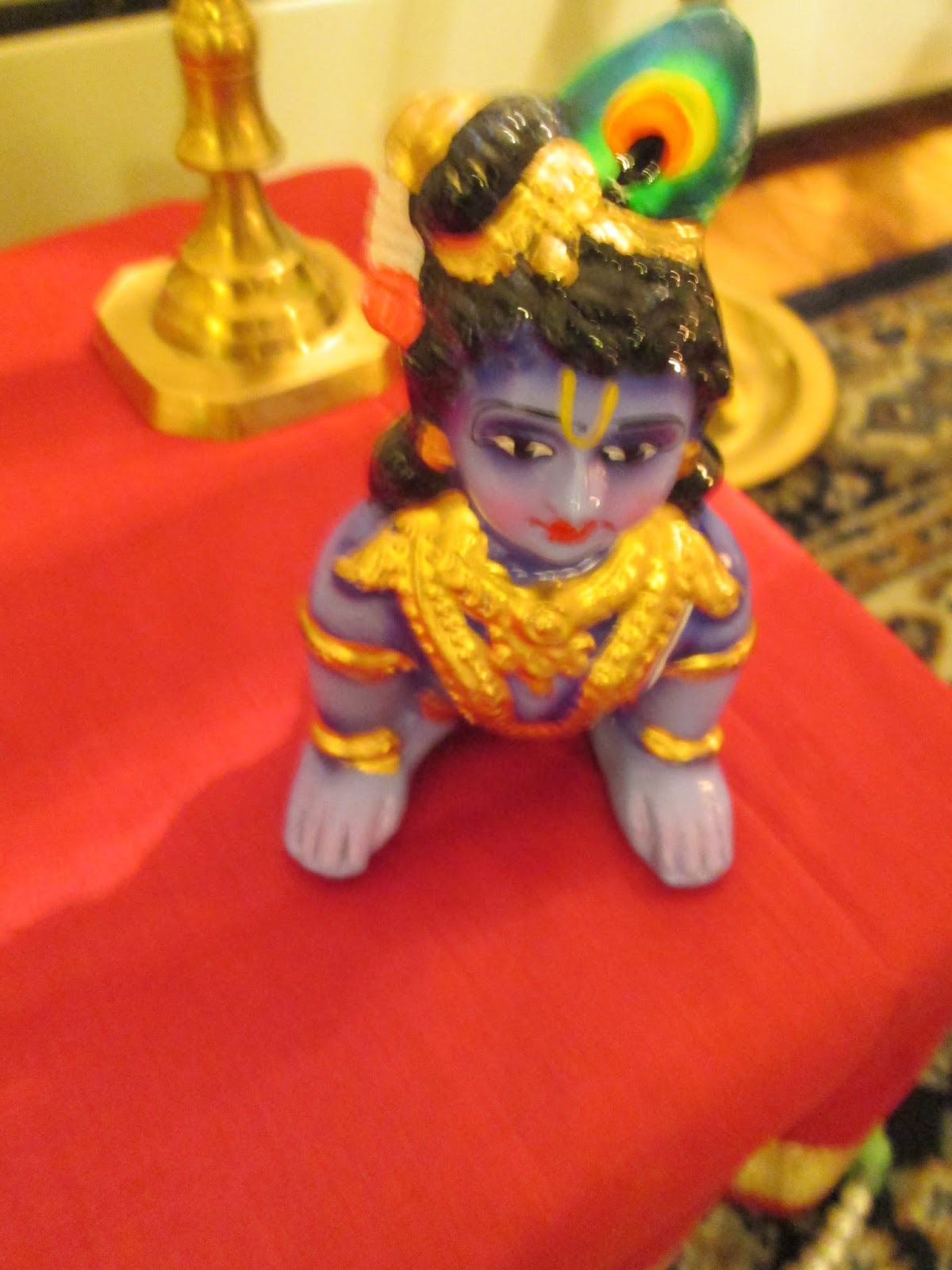
This is the birthday of Lord
Krishna, the eighth Divine Incarnation. It falls on the 8th day of the dark
half of the month of Bhadrapada (August-September). This is one of the greatest
of all Hindu festivals. Lord Krishna was born at midnight. A twenty-four hour
fast is observed on this day, which is broken at midnight.
Temples are decorated for the
occasion. Kirtans are sung, bells are rung, the conch is blown, and Sanskrit
hymns are recited in praise of Lord Krishna. At Mathura, the birthplace of Lord
Krishna, special spiritual gatherings are organised at this time. Pilgrims from
all over India attend these festive gatherings.
The Lord appeared when the
moon entered the house of Vrishabha at the constellation of the star Rohini, on
Wednesday, the 8th day of the second fortnight of the month of Sravana, which
corresponds to the month of Bhadrapada Krishnapaksha according to the
Barhaspatyamana, in the year of Visvavasu, 5,172 years ago (from 1945), which
means 3227 B.C.
Study the Bhagavatam and
the Pancharatras, which are equal to the Upanishads. You will
know all about the glory of Lord Krishna, His Lilas and superhuman deeds. The
eighth Avatara, Krishna, who has become the Beloved of India and the world at
large, had a threefold objective: to destroy the wicked demons, to play the
leading role in the great war fought on the battlefield of Kurukshetra (where
he delivered His wonderful message of the Gita) and to become the center
of a marvelous development of the Bhakti schools of India.
There is no true science
except devotion to Lord Krishna. That man is wealthy indeed, who loves Radha
and Krishna. There is no sorrow other than lack of devotion to Krishna. He is
the foremost of the emancipated who loves Krishna. There is no right course,
except the society of Sri Krishna's devotees. The Name, virtues and Lilas
(divine pastimes) of Krishna are the chief things to be remembered. The Lotus
Feet of Radha and Krishna are the chief objects of meditation.
Sri Krishna is the ocean of bliss.
His soul-stirring Lilas, which are the wonder of wonders, are its waves. The
honeyed music of His flute attracts the minds of His devotees from all three
regions. His unequalled and unsurpassed wealth of beauty amazes the animate and
the inanimate beings. He adorns His friends with His incomparable love.
His palms bear the signs of a
lotus and discus, the right sole of His feet of a flag, lotus, thunderbolt, an
iron goad, barley seed, and the Swastika. His left sole has the rainbow,
triangle, water-pot, crescent, sky, fish, and a cow's footprint. His Form is
composed of condensed universal consciousness and bliss. His Body pervades the
entire cosmos.
Devotion is the only means of
attaining Lord Krishna. Bhakti kindles love for the Lord. When love is directed
towards Krishna, man is freed from the bondage of the world.
Though Lord Krishna appeared
in a human body, He had a divine body not composed of the five elements. He did
not take any birth here in the usual sense of the term. He did not die. He appeared
and disappeared through His Yoga Maya as He has declared in the Gita. This
is a secret, known only to His devotees, Yogis and sages.
His enchanting form with flute
in hand is worshipped in myriads of homes in India. It is a form to which is
poured out devotion and supreme love from the hearts of countless devotees not
only in India but also in the West. Millions of spiritual seekers worship Him
and repeat His Mantra, Om Namo Bhagavate Vasudevaya.
Lord Krishna was great in
knowledge, great in emotion, great in action, all at once. The scriptures have
not recorded any life more full, more intense, more sublime and grander than
the life of Sri Krishna.
Krishna has played various
roles during His stay in the world. He was Arjuna's charioteer. He was an
excellent statesman. He was a master musician; he gave lessons even to Narada
in the art of playing the veena. The music of His flute thrilled the
hearts of the Gopis and everyone else. He was a cowherd in Brindavan and Gokul.
He exhibited miraculous powers even as a child. He killed many demons. He
revealed His Cosmic Form to His mother, Yasoda. He performed the Rasa Lila, the
secret of which can only be understood by devotees like Narada, Gauranga, Radha
and the Gopis. He taught the supreme Truth of Yoga, Bhakti and Vedanta to
Arjuna and Uddhava. He had mastered every one of the sixty-four fine arts. For
all these reasons He is regarded as a full and complete manifestation of God.
Incarnations of God appear for
special reasons under special circumstances. Whenever there is much
unrighteousness, whenever confusion and disorder set in on account of
unrighteousness and baffle the well-ordered progress of mankind, whenever the
balance of human society is upset by selfish, ruthless and cruel beings,
whenever irreligion and unrighteousness prevail, whenever the foundations of
social organisations are undermined, the great Incarnation of God appears in
order to re-establish righteousness and to restore peace.
An Incarnation is the descent
of God for the ascent of man. A ray from the Cosmic Being in His potential
state of manifestation descends on earth with mighty powers to keep up the
harmony of the universe. The work done by the Incarnation of God and His
teachings produce a benign influence on human beings and help them in their
upward divine enfoldment and Self-realization.
The Incarnation comes to
reveal the divine nature of man and makes him rise above the petty
materialistic life of passion and egoism.
The greatest manifestations
are called Incarnations proper. Rishis, Munis, prophets, sons of God and
messengers of God are minor manifestations.
The Incarnations usually come
with their particular or favourite groups or companions. Lord Rama came with
Lakshmana, Bharata and Shatrughna. Lord Krishna came with Balarama, Devas and
Rishis. Sanaka came with Sanandana, Sanatkumara and Sanatsujata. Some, like Sri
Shankara and Ramanuja, come as teachers and spiritual leaders. Some, like
Chaitanya, are born to instill devotion in the hearts of people and turn their
minds towards God. The Incarnations proper, like Krishna, come only when there
is widespread catastrophe in the world.
On the holy Krishna Janmashtami,
the ladies in South India decorate their houses beautifully, ready to welcome
the Lord. They prepare various sweetmeats and offer them to the Lord. Butter
was Krishna's favourite, and this is also offered. From the doorway to the
inner meditation room of the house the floor is marked with a child's
footprints, using some flour mixed with water. This creates the feeling in them
that the Lord's own Feet have made the mark. They treat the day as one of very
great rejoicing. There is recitation of the Bhagavatam, singing and
praying everywhere.
The Janmashtami is celebrated
at the Sivananda Ashram, Rishikesh, with the following program of intense
spiritual activity:
1. During the preceding eight
days, Japa of Om Namo Bhagavate Vasudevaya is done intensely.
2. Those who can, will recite
the Bhagavatam during this period. Others will listen to it being
recited.
3. On the birthday itself
everyone fasts and spends the whole day in holy communion.
4. Everyone greets others with
the holy Mantra, Om Namo Bhagavate Vasudevaya.
5. A grand havan is
performed on that day.
6. There is continuous Satsang
from 4a.m. early in the morning till night. Yogis, Sannyasins and learned men
discourse upon the glorious life and teachings of the Lord.
7. From sunset people assemble
in the elaborately decorated temple and sing the Lord's Names and glories.
8. Many hymns and portions of
the Bhagavatam, especially the Gopika Geetam, are recited.
9. Towards midnight, there is
a grand worship of Lord Krishna. The Lord is bathed with milk while His Name is
chanted 108 times.
10. This worship concludes
with offerings of flowers, waving of lights (Arati), and reading of that
portion of the Bhagavatam which deals with the birth of Krishna. This
synchronises with midnight, the hour of the Lord's birth, at which time the murti
of the Lord is rocked in a beautifully decorated cradle. After this item,
all the assembled devotees partake of the holy prasad or sacrament, and
then retire, filled with the Grace and blessings of Lord Krishna.
If you cannot read the whole
of the Srimad Bhagavatam during these days, at least you should recite
the following four most important verses from the book. The leading two verses
and the closing verse are the prologue and the epilogue respectively:
"Hear from
Me the most secret knowledge coupled with the essential experience and its
component parts.
"May you
realize by My Grace, the knowledge of Myself and what form, qualities and
actions I am endowed with.
1. "Before creation I
alone existed. There was nothing, neither existence nor non-existence. I am
that which remains after dissolution.
2. "Understand that to be
Maya or illusion which is devoid of any purpose, which is not to be found in
the Self and which is unreal like light and darkness.
3. "As the primary
elements are amalgamated, with one another and also separate from one another
at the same time, so I pervade the whole universe and am also separate from it.
4. "The aspirant should,
by the method of positive and negative, know that thing which exists always and
everywhere.
"Experience
this truth through the highest superconscious state so that you will not be
disturbed even by illusory objects".
There is another beautiful
verse in the Bhagavatam which you can recite daily: "In days of
yore, the Lord, born of Devaki, brought up in the house of Yasoda, killed the
wicked Putana of illusive form and lifted the Govardhana hill, killed Kamsa and
the sons of the Kuru race, and protected the sons of Kunti. Thus is recited the
essence of the ancient Bhagavat Purana consisting of the nectarine
stories of the deeds of Lord Krishna".
May the blessings of Lord
Krishna and Sri Radha be upon you all!
Excerpts from:
Krishna
Janmashtami by Swami Sivananda
If you would like to purchase the print edition, visit:
http://www.dlshq.org/cgi-bin/store/commerce.cgi?
http://www.dlshq.org/cgi-bin/store/commerce.cgi?
If you would
like to contribute to the dissemination of spiritual knowledge please contact
the General Secretary at:

